March 2026
Hello! Today we have the honour of speaking with two wonderful people together. To start: could you tell us a little about yourselves?
By : By Lily_Kinbaku & SudoJute (Fetlife)
L: I am Lily, I live in Cape Town, and am originally from Pretoria. I definitely identify more as a model although I have recently found it extremely satisfying to have begun to start tying my partner – Sudo, here – seeing the experience, and how he feels the ropes. It’s fascinating: as a model I know how I feel rope on my body and I can see that he feels it very differently in his.
S: And I am Sudo: I mainly tie – but I am currently exploring being tied by Lily; and this is opening a whole new field of exploration for me.
When did you first encounter rope?
S: Very first, about 20 years ago in Tokyo – and then I started trying to find material; it was after this that I studied in Copenhagen with Max (of the Copenhagen Shibari Dojo). Lily came here to Denmark with me the next time – we undertook a one-and-a-half-week intensive with Max and Tina. It was private tuition, and it really changed things. Afterwards we continued studying, and for the last three years we’ve been tying more seriously and more regularly.
Together we are part of a collective that runs Embodiment Rope Space -this is a queer-friendly, queer-focussed rope space in Cape Town that exists primarily as a safe space for kinksters to attend in whatever expression they need: and a place to teach rope safely, with a view to building something sustainable over time.
L: It was indeed 2006, when Sudo came back from Japan with a special box – and inside was one rope, one true, Japanese rope. Such fond memories.
We started tying on and off, struggling somewhat as there was such a lack of education available for us. Over time, since then, it really has been on and off…
S:…It was so difficult to find information in our home country back then, so I guess it began with slow experimentation, frustration, continuing to come back to the ropes, and to try again.
And from those experiences: what would be your favourite/funniest/best memory of tying or being tied?
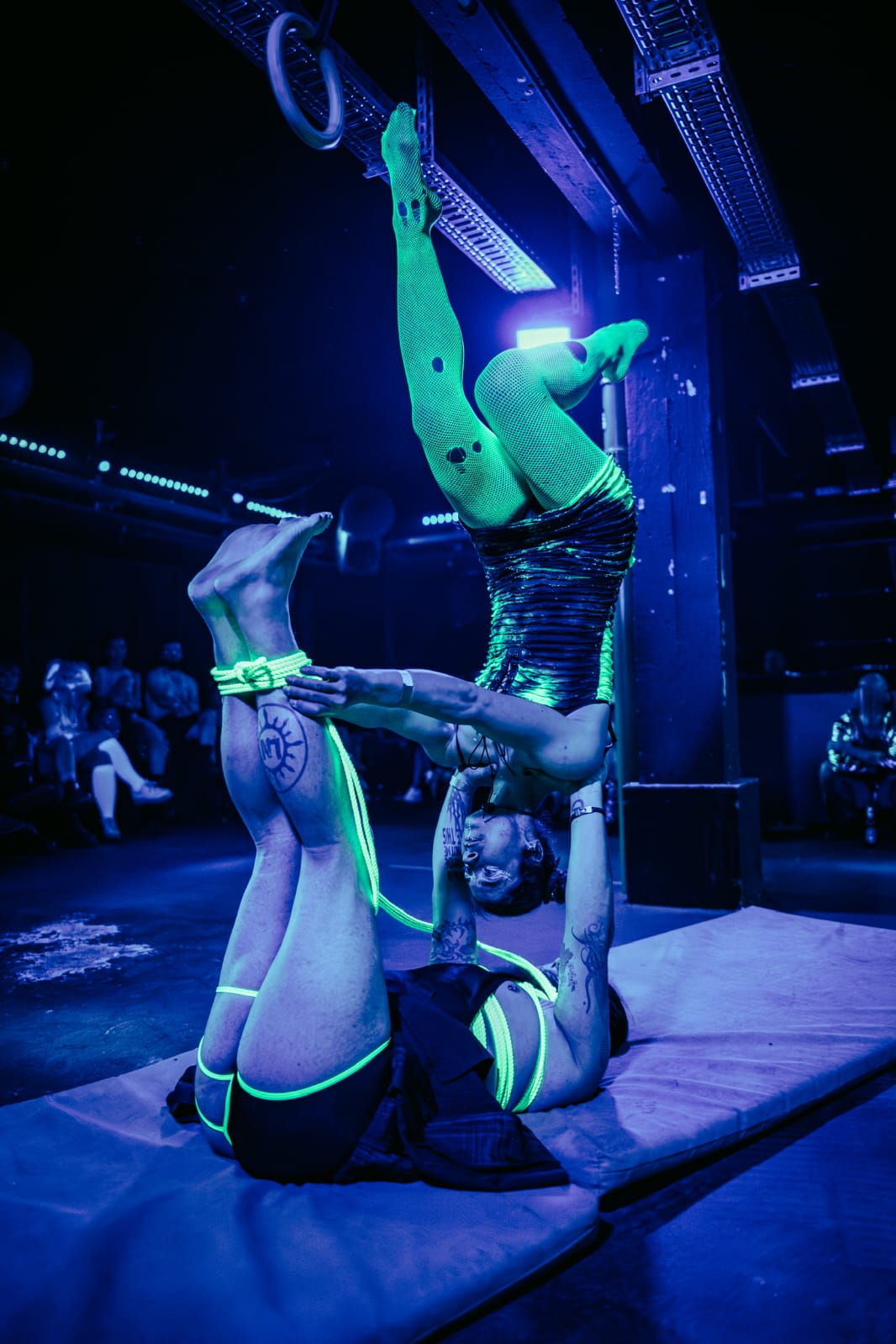
L: Oh there are a couple! And rather personal. A big one for me was the first time we did a public performance, as before then we had been quite private. So thinking back to that evening, that occasion: it was very memorable.
S: For me, also, the first public performance –
L: That first time we performed in a club: it was really amazing. We really enjoyed it.
S: It had been such a private practice for us, so really stepping into a public space and openly sharing in such an intense environment – we found ourselves leaning into uncomfortable places. The environment, the novelty – they amplified the experience for us, significantly.
L: The intensity, the high stress and improvisation of the club environment. Needing to make changes despite having planned – because of course, you don’t want to get hurt! – that spontaneity, I found that very exciting…
S: …In a rope partnership this is so powerful – we really faced what were, for us, novel conditions. For instance, we hadn’t bargained on being nearly unable to communicate as expected. Visibility was very low most of the time: so possibly not ideal for the first experience! But it was an incredibly bonding experience for us in our partnership, because of it.
You both have experience of learning to tie, and to be tied. What is something you’d tell people just getting started, or who are curious about rope?
L: Go slow! Slow! It is important to learn the basics right – and then you can progress. Just take time, go slow, and do it right at the foundational level.
S: It’s very easy when you start out, to imagine that there is some ultimate goal to “achieve” – and working towards certain positions, or being able to take certain images: something ‘spectacular’. And I think, that perhaps makes many people miss the beauty and the juiciness along the way.The learning, the small gestures, the discovery – so along with that goal, I would suggest to be open to being surprised, to being able to gradually refine WHY you are doing rope – because it is an extremely personal journey and very different for different people. Instead of holding on to a borrowed end goal, or inherited idea of what it “should” be: keep your own compass, yet discover, slowly, where it is pointing you. Because discovery is part of the journey.
Would you like to tell us about any hopes, dreams or goals you have for your rope life? Anything you are really looking forward to?
S: I think, life has been intervening and we definitely want to get back to regular rope practice because there are so many things that we still wish to explore. Part of it is rediscovering basics, part of it is pushing limits. We would love to further our education, to build new experiences. We would love to find a way to make Embodiment Rope Space sustainable – as a learning space and as a safe space.
And then, also, alongside that, develop our private salon space. This is meant to be a much smaller, perhaps more intense, space of possibility for tying and exploration.
L: There is a lot that I would love to feel in rope – so much more. And I would love to learn to tie more – I want to be able to tie my partner in meaningful ways, and to do it well.
I would also really like to make small, 25x25cm more or less hand-bound art books of specific people’s work. I would start with our own, and then the work of other people that I have in mind – to craft really beautiful inkjet printed works in beautiful boxes. What a dream.
Vil du være med?
Vi vil så gerne høre fra dig!
Uanset du er erfaren, nybegynder, rigger, model, switch eller noget helt andet
Kontakt os gerne!
En stor tak til vores sponsore og samarbejdspartnere